The Short Answer: How Long Does SEO Take?
01
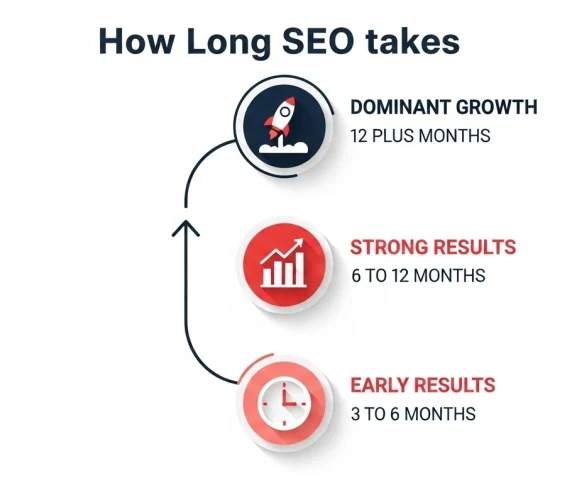
Early results → 3 to 6 months
02
Strong, sustainable results → 6 to 12 months
03
Dominant, compounding growth → 12+ months
You’ve hired an agency, optimized your website, published blog posts — and still, nothing. No calls. No traffic. No leads. Sound familiar?
This is the number one frustration we hear from business owners at PW Digital Solutions. And honestly? It’s completely understandable.
The real problem isn’t that SEO doesn’t work. The problem is that nobody told you the truth about how long it actually takes — and why. So let’s fix that right now.
In this guide, we’ll give you a real, honest SEO timeline for 2026, explain the factors that speed up or slow down your results, and tell you exactly what you should be seeing month by month. No fluff. No vague answers. Just the truth.
Most reputable SEO professionals agree that you should expect to wait at least 3 to 6 months before seeing any meaningful movement. For competitive industries or national keywords, that window stretches to 6 to 12 months — sometimes longer.
That said, several factors can speed this up or slow it down dramatically. Let’s break them all down.
Most people think SEO is slow because agencies are lazy. That’s not it.
The real reason is that Google’s entire ranking system is built around trust — and trust takes time to build, no matter how good your content is.
Here’s what Google actually does before ranking your page:
According to Google’s own Search Central documentation, crawling, indexing, and ranking are three entirely separate processes — each taking their own time.
This is why even a perfectly optimized website can take months before it starts climbing. Google doesn’t want to promote a brand-new website that might disappear next month. It needs proof that you’re here to stay.
Not all websites take the same time to rank. Here are the biggest factors that determine how quickly you’ll see results:
1. Website Age & Domain Authority
A brand-new website with zero history will always take longer than an established domain. Google needs time to verify your site is legitimate and trustworthy. If you’re starting fresh, expect results to take closer to 6 to 9 months.
2. Level of Competition in Your Niche
Are you trying to rank for “plumber in your suburb” or “best accounting software”? Local, niche keywords with low competition can show results in as little as 2 to 3 months. Highly competitive industries like law, finance, or e-commerce can take 12 months or more. Our SEO services at PW Digital Solutions always begin with a thorough competitor analysis to set realistic expectations from day one.
3. Content Quality & Depth
Thin, surface-level content does not rank in 2026. Google’s algorithms reward content that genuinely solves problems, goes deep on topics, and satisfies user intent. If your content is weak, even great technical SEO won’t save you.
4. Your Backlink Profile
Backlinks — other websites linking to yours — are still one of Google’s strongest trust signals. A site with zero backlinks will rank much slower than one with quality links from authoritative sources. Building backlinks takes time and consistent effort, which is why we include it as a core part of our Digital Marketing strategy.
5. Technical SEO Health
If your website is slow to load, not mobile-friendly, has broken links, or duplicate content — Google will struggle to rank it, no matter how good your content is. Technical issues are like roadblocks that stop crawlers in their tracks. These must be fixed in Month 1, not Month 6.
6. Consistency of Effort
SEO is not a one-time project. Businesses that publish fresh content regularly, update old pages, and keep building links see results much faster than those who do it once and stop.
Here’s exactly what you should expect at each stage of your SEO journey:
| Month | What to Expect |
|---|---|
| Month 1–2 | Technical fixes, keyword research, content planning, full site audit |
| Month 3–4 | Google starts crawling your site, minor ranking movements begin |
| Month 4–6 | Early keyword rankings appear, organic traffic starts picking up |
| Month 6–9 | Noticeable traffic growth, leads start coming in, rankings stabilize |
| Month 9–12 | Consistent page-1 rankings, strong ROI becomes visible |
| Month 12+ | Compounding growth, dominant positions, ongoing lead generation |
Keep in mind — this is a general guide. Your results will vary based on the factors above. But this gives you a realistic roadmap so you know what to expect, and when to be concerned if things aren’t moving.
One of the most important distinctions that affects your timeline is whether you’re targeting local or national keywords.
Local SEO — Faster (2 to 4 Months)
If you’re a local business targeting customers in a specific city — like “carpet cleaning in Brisbane” or “web design Sydney” — local SEO is significantly faster to produce results. Why? Less competition, and Google’s local map pack is heavily influenced by your Google Business Profile, which can be optimized immediately.
National / E-Commerce SEO — Slower (6 to 12+ Months)
Trying to rank nationally for competitive terms takes considerably longer. You’re competing against established brands with thousands of backlinks and years of authority. For our e-commerce clients, we typically set a 9 to 12 month runway before expecting dominant first-page rankings on commercial keywords.
If you’re past the 6-month mark and seeing zero improvement, here are the most common reasons why:
According to Ahrefs’ research on why pages don’t rank, over 90% of pages get zero organic traffic — and the number one reason is simply a lack of backlinks.
While you can’t force Google to rank you overnight, these strategies will accelerate your timeline significantly:
Start With Long-Tail, Low-Competition Keywords Instead of chasing “digital marketing agency” right away, target “digital marketing agency for small businesses in [your city].” These are easier to rank for and drive more qualified traffic.
Publish Content Consistently Aim for at least 2 to 4 blog posts per month, each targeting a specific keyword and genuinely helping your audience solve a real problem. Google rewards websites that stay active.
Fix All Technical Issues in Month 1 Get a proper SEO audit done at the very start. Fix site speed, mobile responsiveness, broken links, and crawlability issues before anything else. Our Website Development team can handle all of this for you.
Build Quality Backlinks Every Month Reach out for guest posting, get listed in relevant directories, and earn links through high-quality content. Even 3 to 5 quality links per month compounds significantly over time.
Optimize Your Google Business Profile If you’re a local business, this is the fastest win available. A fully optimized profile with regular posts, photos, and reviews can get you into the local map pack within weeks.
Track Your Progress Monthly Set up Google Search Console and Google Analytics from Day 1. Monitor keyword rankings, organic traffic, and click-through rates every single month. If something isn’t moving, adjust quickly.
Absolutely — and here’s what makes SEO completely different from every other marketing channel:
Paid ads stop the moment you stop paying. SEO keeps compounding.
A blog post you publish today could be driving leads for you 3 years from now. A first-page ranking you earn in Month 9 doesn’t disappear when you stop paying a monthly invoice. The results you build with SEO become a permanent asset for your business.
Yes, it takes time. Yes, it requires consistency. But for every month you delay starting, your competitors are getting further ahead — and it becomes harder and more expensive to catch them.
The businesses that commit to a 12-month SEO strategy don’t just rank — they dominate. They stop chasing customers and start attracting them automatically.
Stop guessing and start growing. PW Digital Solutions offers a FREE SEO Audit that shows you exactly where your website stands, what’s holding you back, and a clear action plan to fix it.
✅ No obligation. No fluff. Just real results.
Book Your Free SEO Audit Today → Contact PW Digi

9200 Belvedere Rd STE 104, Royal Palm Beach, FL 33411
Suite #1027 30 Denison Street Bondi Junction, NSW 2022
ABN 96 667 983 815
I agree to all your terms and policies